J. & J.G. Low: Rare Early Hand-Modeled Tile and Remarkable Glazes
Some tiles were made to cover a wall. A few were made to be looked at the way a painting is looked at — framed, hung, lit, and returned to. The work that left a small factory in Chelsea, Massachusetts, in the last quarter of the nineteenth century belongs to the second kind, and more than a hundred years later it still stops a collector mid-step.
A factory born at the Centennial
The story starts at the 1876 Centennial Exhibition in Philadelphia, where the decorative tiles of England and Europe were set in front of an American public that had never made their equal. One of the people who walked through was John Gardner Low — born in Chelsea in 1835, trained as a painter in Paris under Thomas Couture, and already working in clay at the nearby Chelsea Keramic Art Works. What he saw in Philadelphia set his course. In 1877 he founded a tile works in Chelsea with his father, John Low, and the firm took the name J. & J.G. Low Art Tile Works.
The firm rose fast. Through the 1880s it took awards on both sides of the Atlantic — an unusual thing for an American tile maker going up against established English potteries. In these years the name changed to J.G. & J.F. Low Art Tile Works, when John Gardner Low’s son, John Farnsworth Low, stepped into the partnership in place of his retired grandfather.
Arthur Osborne and the plastic sketches
The hand behind most of the firm’s tiles belonged to an English sculptor named Arthur Osborne. Born in Faversham, Kent, in 1855, he came to the United States in 1878 and joined Low the following year, soon becoming its chief designer and modeler. He shaped the great majority of the company’s tiles, and his mark — an A inside a circle, or the initials AO — is worked into the design or pressed into the back.
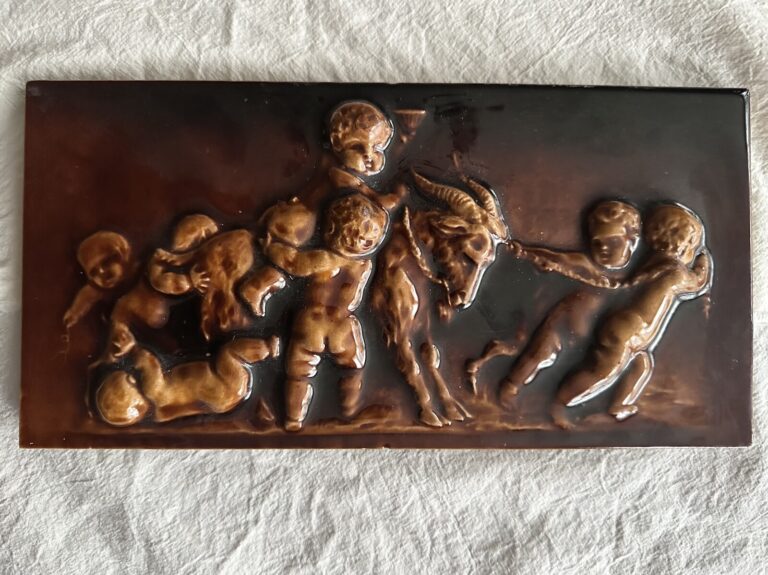
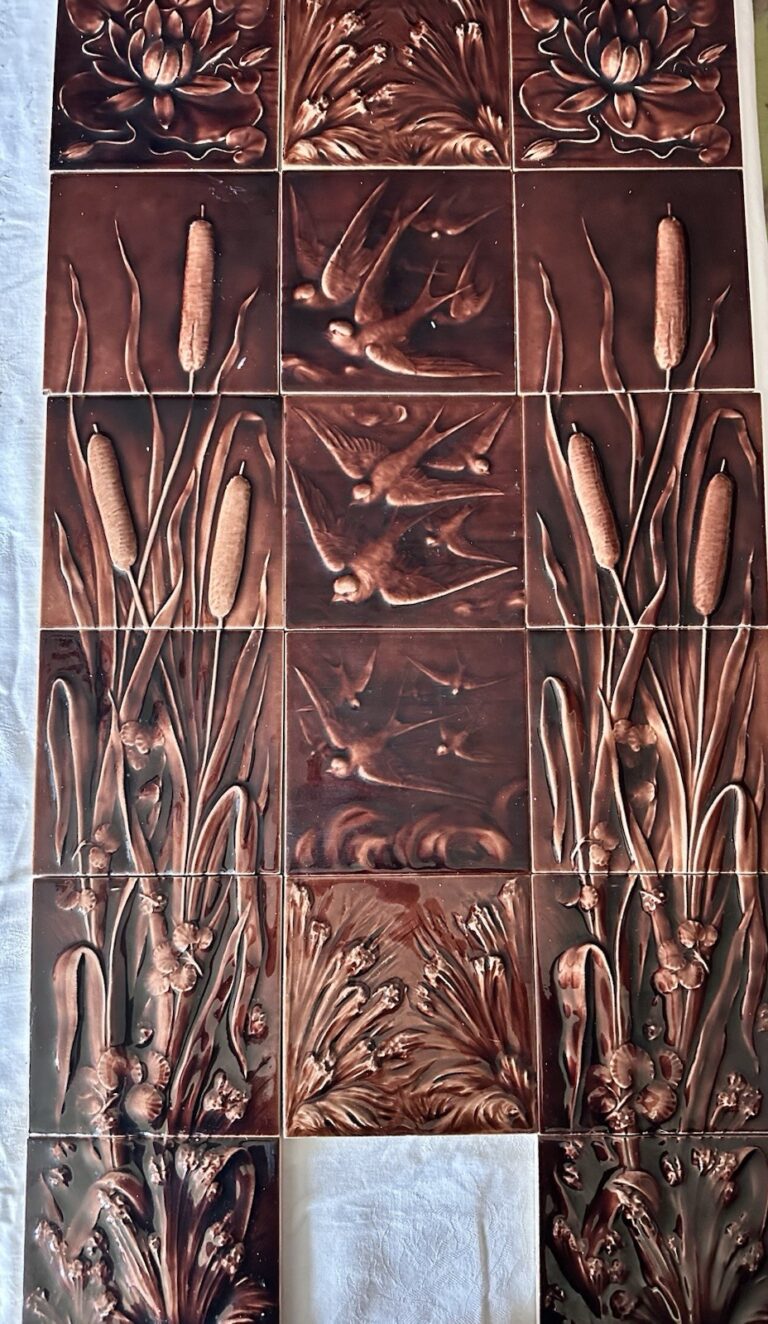
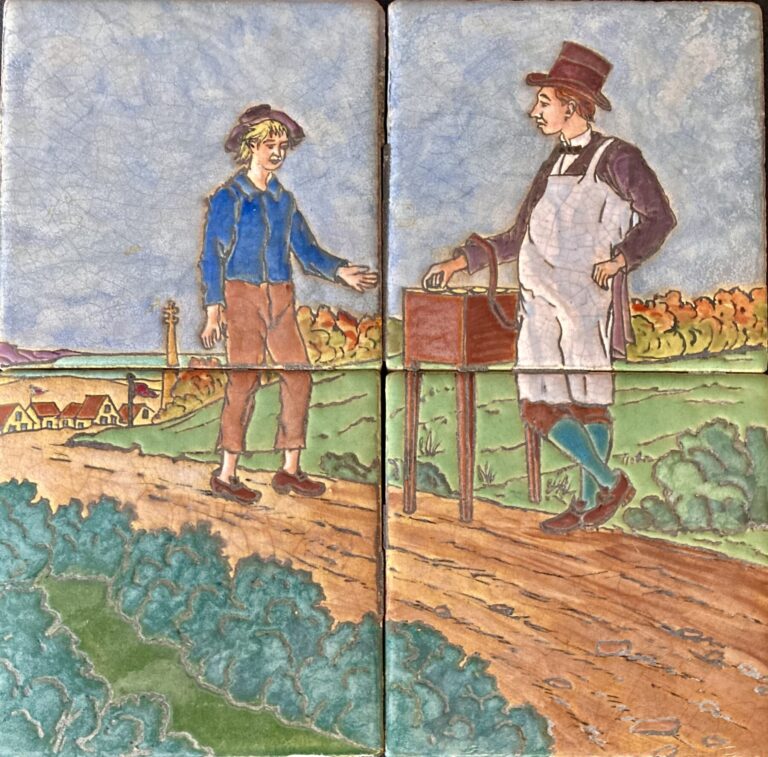
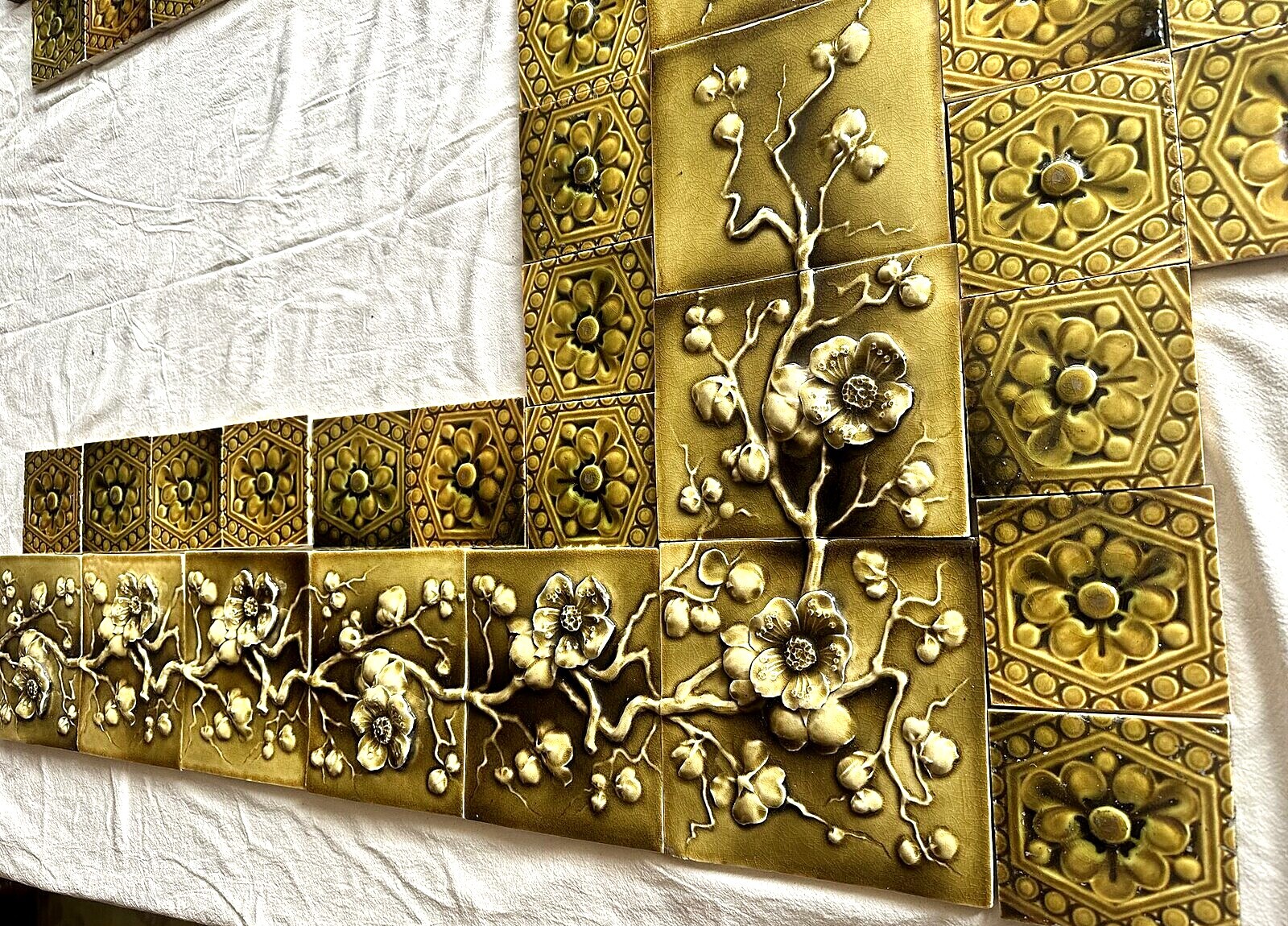
Osborne’s signature achievement was a line Low called plastic sketches: low-relief sculptural tiles and panels modeled in wet clay and meant to be framed and hung like oil paintings. No other tile maker, in England or America, had treated tile quite this way — as art in its own right rather than surfacing for a wall. The subjects ran wide: portraits, classical and mythological scenes, animals and birds, pastoral and genre studies. Low’s transparent colored glazes, washed over the relief, gave the scenes a play of light that flat painting on tile could never reach.
Why the early work matters
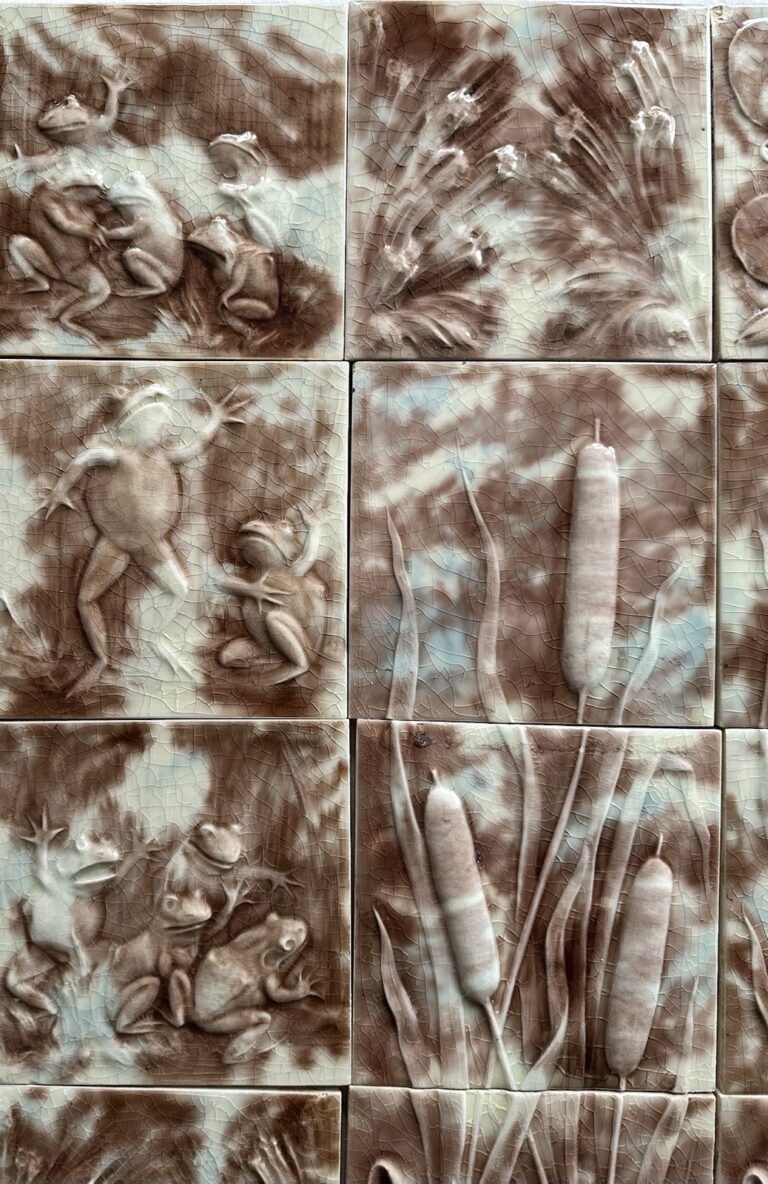
Several things make the early Low tiles so prized. The relief is deep and sure — the work of a trained sculptor, not a pattern stamped out by rote. The glazes — ambers, greens, and the iridescent and transparent colors the firm became known for — sit down in the modeling, so the surface shifts with the light and the angle you stand at. And because Low sold certain catalogs as art books and sold the plastic sketches to be framed, a real number of pieces were cared for as art from the start, rather than mortared into a wall and forgotten.
Low tiles also tend to be well marked, which helps. Most carry an impressed maker’s mark on the back, often with a date and copyright, and frequently the title of the image. Attribution of a genuine Low piece tends to be firmer than for many of its contemporaries.
A nursery for American ceramics
The Low works mattered beyond its own output because of who passed through it. George W. Robertson, a chemist and glaze expert at Low, left to found Robertson Art Tile in Morrisville, Pennsylvania, in 1890. William H. Grueby, who spent about ten years with the firm, went on to found Grueby Pottery in 1894 and gave the Arts and Crafts movement its famous matte Grueby green. Osborne himself returned to England in 1898, to Faversham, where he made the molded Ivorex plaques he is still known for. The Chelsea factory was, in effect, a training ground for some of the most important names in American art tile.
The end, and the long afterlife
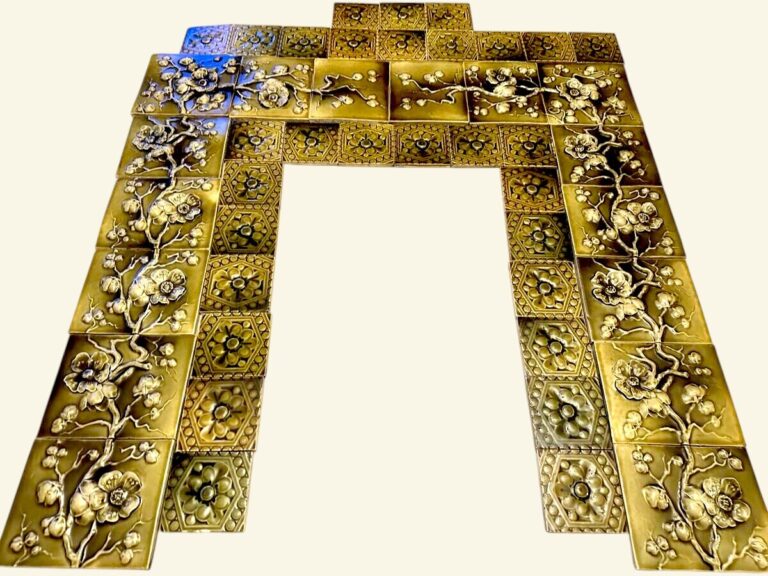
The firm’s active life ran from 1877 to about 1902 before the market and the company wound down. The afterlife has been long. Low tiles sit today in major museum collections, and the plastic sketches in particular are collected as the small sculptures they were always meant to be. For anyone restoring a period fireplace, or hunting a single great pictorial to frame, an authentic Low tile is still one of the high points of the American art-tile era.
Relic Asylum — Tiles with past lives.
Low at Relic Asylum

Sources & further reading
- Primary catalogs (public domain): the 1884 and 1887 Low illustrated catalogues and Osborne’s Plastic Sketches, digitized in the Low Art Tile Book Collection, VCU Libraries Digital Collections. Catalog images courtesy of VCU Libraries Digital Collections, public domain.
- J. & J.G. Low Art Tile Works at The Metropolitan Museum of Art — collection examples and marks.
- J. & J.G. Low Art Tile Works — Wikipedia — footnoted overview.
- Richard Pennington, Low Art Tile: John Gardner Low & the Artists of Boston’s Gilded Age (2010) — the standard reference on the firm.