Simple Simon Met a Pieman: A Lost AETCo Fairy-Tale Tile
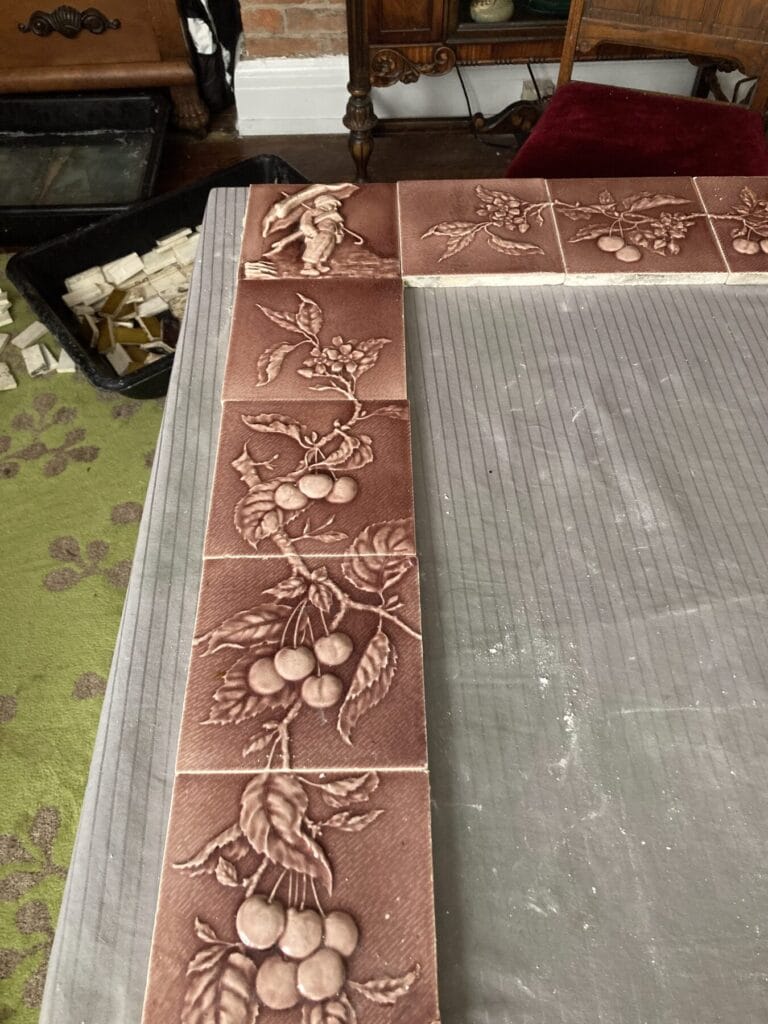
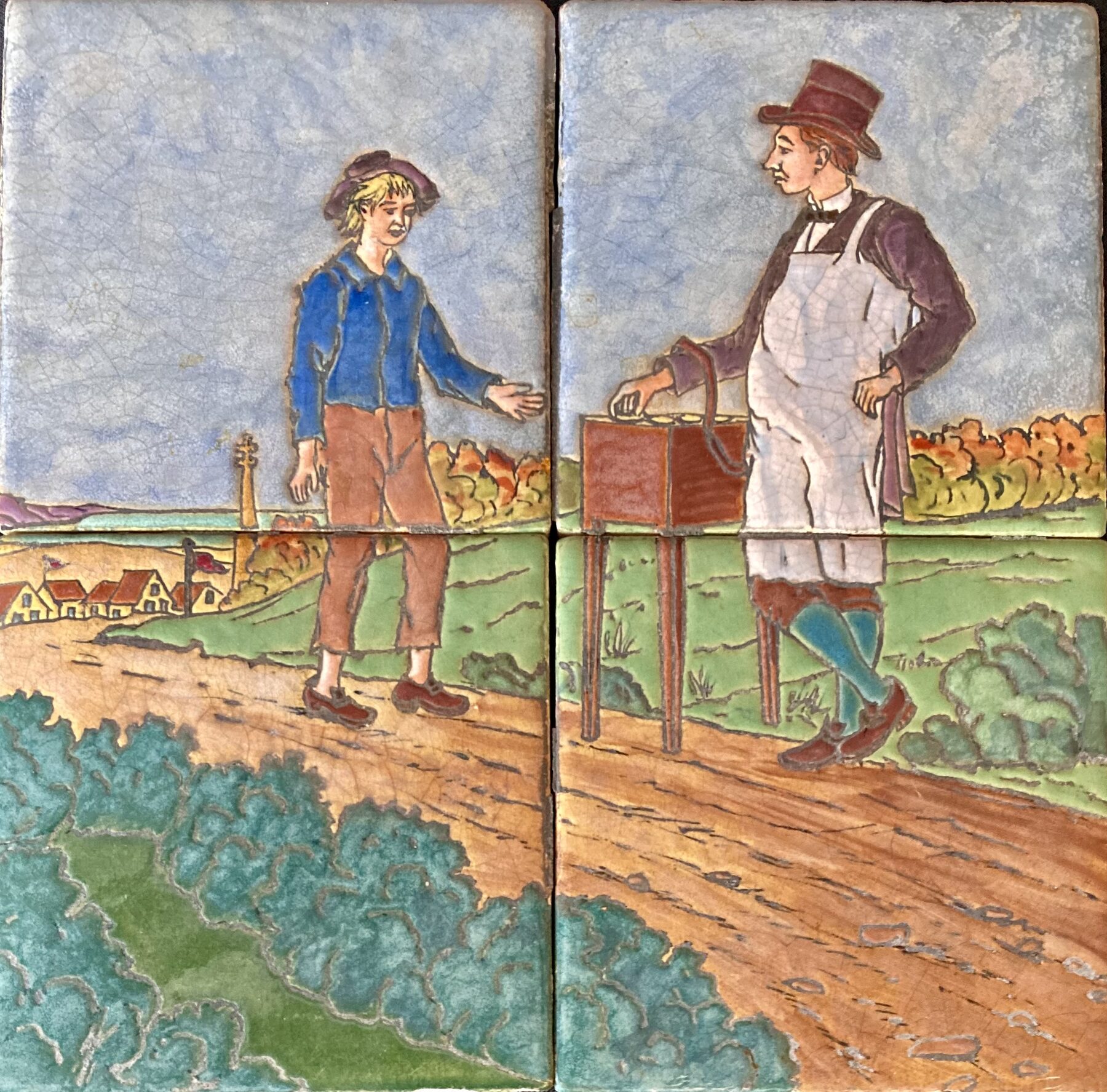
On a country path, under a soft crackled sky, a fair-haired boy in a blue jacket and brown breeches reaches toward a man in a tall hat and apron, his pie-case balanced on a folding stand. Behind them a village rolls down to a church spire and a stand of autumn trees. It is the oldest of jokes in the oldest of rhymes — Simple Simon met a pieman, going to the fair — painted by hand across four tiles of faience.
One scene of a nursery-rhyme set
Simple Simon did not come alone. He was one panel in a set of nursery-rhyme scenes — among them Tom, Tom, the Piper’s Son running off with his stolen pig, Simple Simon gone a-fishing in his mother’s pail, two boys peering over a stone wall, and a Hey Diddle Diddle that got away — all painted in the same soft, storybook palette of crackle-glazed faience. They are the work of the American Encaustic Tiling Company of Zanesville, Ohio, made to brighten the places children passed through.
Made for a Milwaukee schoolroom?
This set surfaced in a box in the basement of an estate sale — and that, with a little history, hints at where it began. Milwaukee had a real tradition of building art tile into its public spaces: theaters, halls, and schoolhouses were given hand-painted faience by makers like American Encaustic and Rookwood. Nursery rhymes in a durable, washable, beautiful surface were exactly the sort of thing a school commissioned for a corridor or a kindergarten. It is more than possible these were made for one.
The likely hand
There is a name that fits the gap. Karl Bergmann, Brussels-trained, designed at the Mosaic Tile Company and then American Encaustic before founding his own Continental Faience and Tile Company in Milwaukee. Tiles like these — AETCo faience that turned up in Milwaukee — sit squarely in his world, and the attribution to Bergmann is a natural one, even if the documentation to nail it has not surfaced. The designs themselves were very likely drawn from the storybook illustrations of Walter Crane, whose nursery-rhyme pictures shaped how a whole era imagined these scenes.
Lost on the road
One of these panels did not survive its last journey. The day it shipped to its buyer, a freight truck on the highway out of Cincinnati caught fire — and the tile, with its hundred years and its small painted joke, was lost in transit and never recovered. A century of survival ended on an interstate shoulder.
Relic Asylum records it here anyway. Not every relic makes it to the next wall; some are lost in the carrying. But it existed, it was beautiful, and the fact of it — painted in a Zanesville factory, very likely bound once for a Milwaukee schoolroom — is worth keeping, even after the tile itself is gone.
Relic Asylum — Tiles with past lives.