From Encaustic to Art Tile: How American Tile Was Made
Every tile in the collection is a record of how it was made. Run your thumb across a Victorian floor and you feel one method; hold a Low relief to the light and you see another entirely. The century of American architectural tile is, underneath the glaze, a story of technique — borrowed from England, mechanized in Ohio, and finally raised into art. Here is how it evolved.
Encaustic: color that runs through the clay
The oldest method on this list is also the most durable. In an encaustic tile, the pattern is not painted on the surface — it is inlaid, one colored clay set into another, so the design runs clear through the body of the tile and never wears away. Revived from medieval floors by English makers like Minton in the nineteenth century, encaustic and geometric tile paved the entryways and vestibules of Victorian America. Because the color is structural, these floors look nearly as they did a hundred years ago. See the encaustic and geometric floor tiles →
The dust press: how tile became American
What let American factories overtake the English imports was a machine. The dust-pressing method — compressing nearly dry clay powder under enormous pressure in a metal die — produced flat, dimensionally exact tiles quickly and by the thousand. It is the reason a company like the American Encaustic Tiling Company could become the largest tile works in the world: dust-pressing turned tile from a craft into an industry, and made the plain field tile that filled every fireplace and bathroom of the era.
Relief and intaglio: the sculptor’s hand, repeated
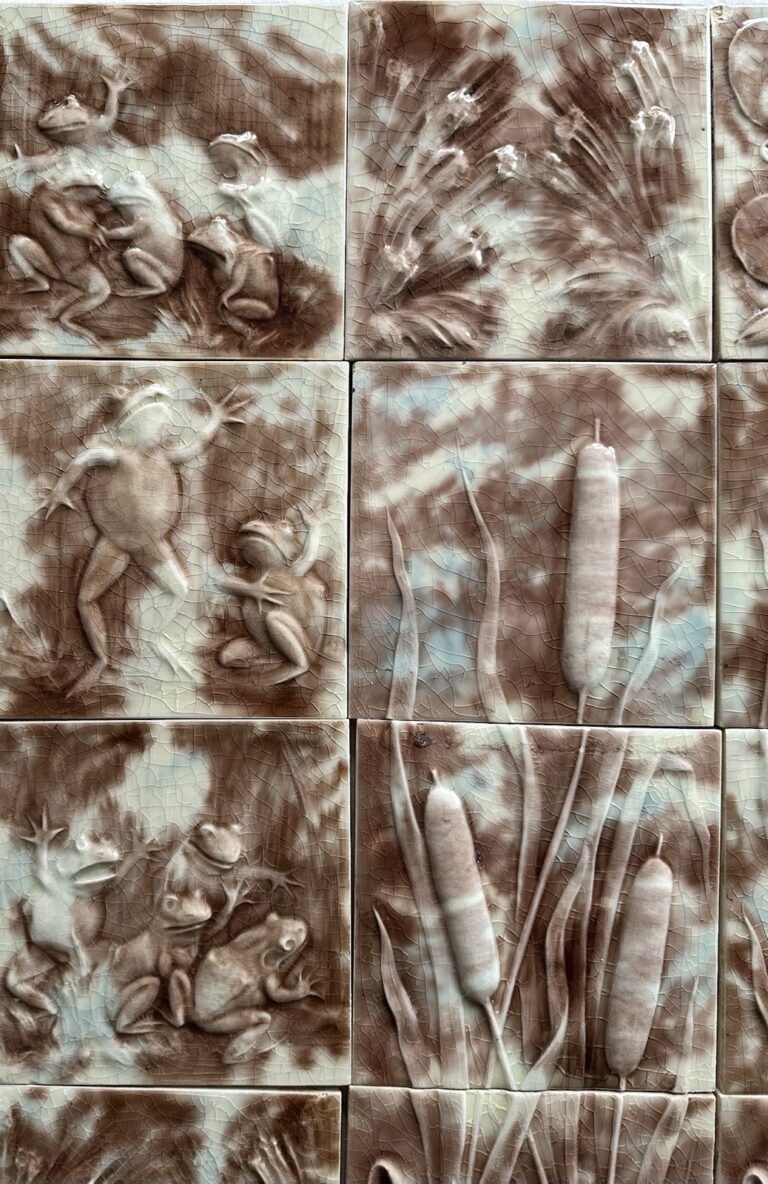
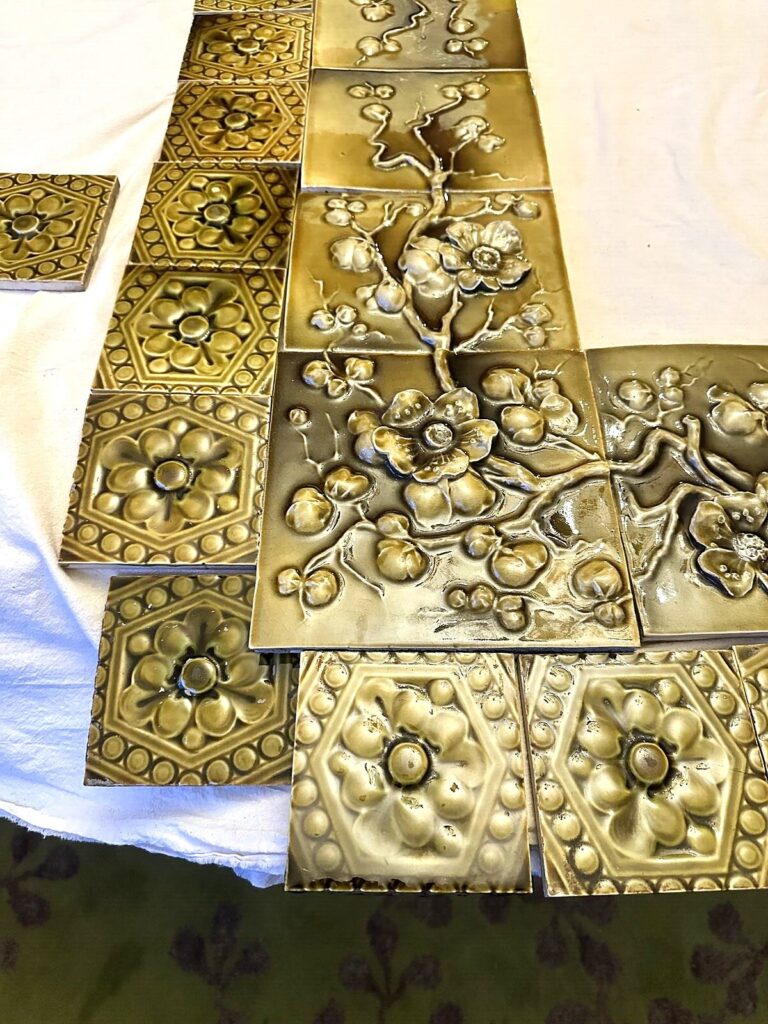
Art tile begins where the mold does. A sculptor first modeled a design in wet clay — a branch of apple blossom, a frog in a procession, a lady with her hounds — and from that master a mold was taken. Every production tile was then pressed against the mold, so it carried the sculptor’s modeling faithfully into its face, whether in raised relief or sunken intaglio. This is why the best pictorial and relief tiles look modeled rather than stamped: behind each is a single artist’s hand, made repeatable.
Glaze: the difference between good and great
Relief only matters if the glaze answers it. Poured over deep modeling, a transparent or majolica glaze pools in the hollows and thins over the high points, so the surface shifts with the light — the effect the J. & J.G. Low works became famous for. Others pursued the opposite: the matte, vegetal glazes of the Arts & Crafts movement, dead-flat and organic. And for pictorial faience, decorators used cuerda seca — a waxed line, mixed with mineral, laid down to keep one color from running into the next during firing, leaving the fine dark outlines you see on theater and schoolhouse tile.
Painted by hand, one tile at a time
At the top of the craft sat the hand-painted pictorial panel. Working from a full-size cartoon, a factory artist painted a scene across a grid of individual tiles — the flamingos of the Mosaic Tile Company, a frog’s wedding in a marsh — so that, fired and set, the joins vanished and the image read whole. Because every tile was painted by hand, no two panels were ever exactly alike, which is why complete, intact examples are so rare.
The arc of it
The century runs in a clean arc: imported English encaustic gives way to American dust-pressed field tile; industry funds an art-tile boom of relief and remarkable glazes; the boom peaks in hand-painted pictorial work — and then the Depression and changing taste bring most of it to an end. Every piece Relic Asylum rescues sits somewhere on that arc. Knowing where is half of knowing what you hold.
Relic Asylum — Tiles with past lives.