Pewabic Pottery: Detroit’s Living Iridescence
Nearly every great American art-tile works closed with the Depression. One did not — and it is still firing today. Pewabic Pottery of Detroit, founded in 1903, remains the living link to the golden age of American tile, and its iridescent glazes have never been equalled.
A chemist-artist and a kiln man
Pewabic was founded by Mary Chase Perry Stratton, an artist and educator, and Horace J. Caulkins, a dental-supply maker who built kilns. They began in a converted stable in Detroit’s Brush Park in 1903, moved to East Jefferson Avenue in 1907, and by 1912 occupied the now-iconic Tudor Revival pottery designed by the architect William Buck Stratton. The name comes from a copper-mining region of Michigan’s Upper Peninsula — “Pewabic,” a word meaning clay with a metallic glint.
The iridescent glazes
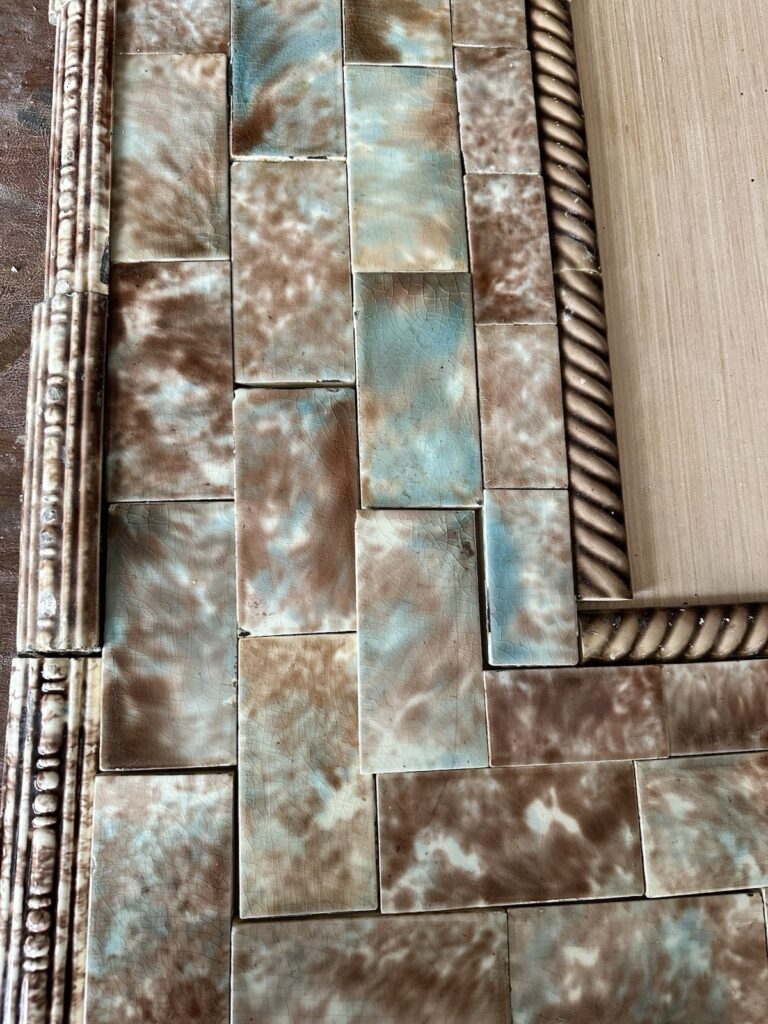
Mary Chase Perry Stratton was among the first in the Western world to formulate true iridescent glazes, and she formulated them by the hundred. Fascinated by the luminous luster of twelfth-century Syrian ware — introduced to her by the collector Charles Lang Freer — she chased those ancient surfaces until Pewabic’s shimmering, shifting glazes became its signature. They face landmark buildings across the country, from the Shedd Aquarium to the Basilica of the National Shrine.
Still here
Designated a National Historic Landmark in 1991, Pewabic still operates as a working pottery, school, and museum — which means a Pewabic tile might be a century old or a signed modern edition, and both carry the same lineage. It is the rare maker in this archive whose story has no ending.
Marks & identification
Pewabic tiles are typically marked with the impressed or stamped Pewabic name, often with the maple-leaf-and-letters device; modern editions may be signed and dated. The unmistakable tell, though, is the glaze — that deep, metallic iridescence is very hard to fake.
Relic Asylum — Tiles with past lives.