The Lady and Her Hounds: A Rare Kensington Three-Tile Relief
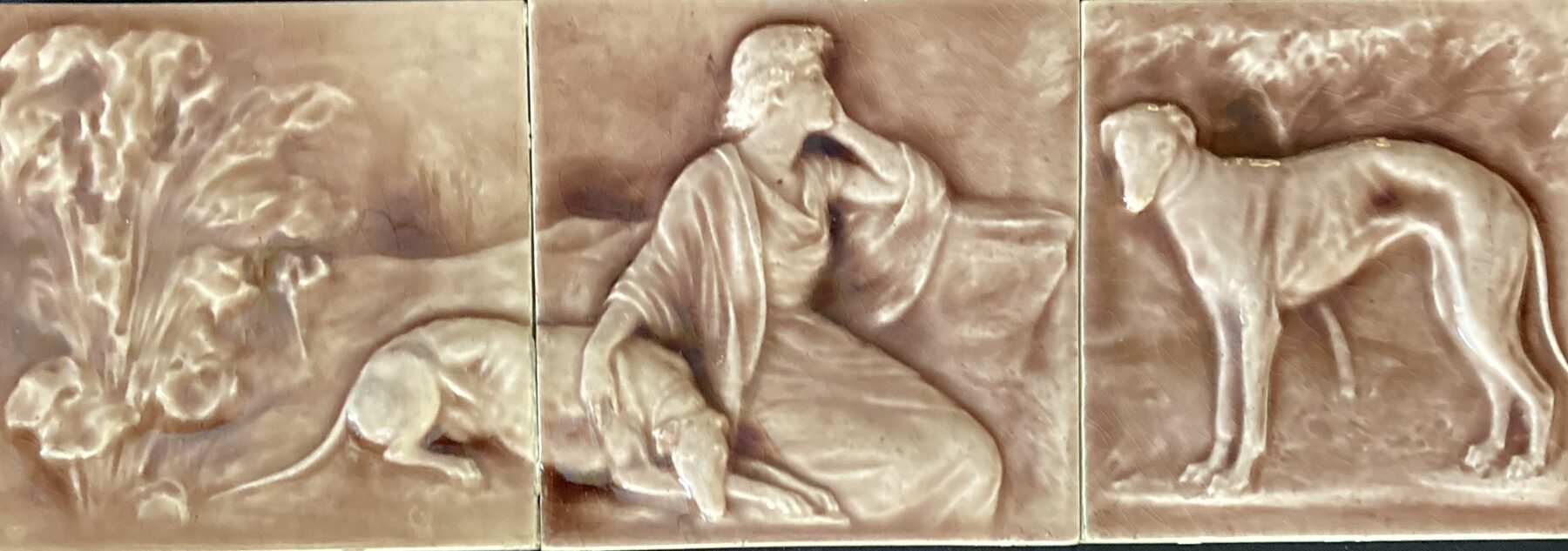
Three tiles, read left to right like a sentence: a hound crouched low among the reeds; a robed woman reclining on a bank, one hand fallen to the head of a dog at her side; and a tall hound standing alert against the brush. All of it modeled in deep relief and washed in a single soft rose glaze, so the whole scene reads as sculpture caught in clay.
The modeling
What sets the set apart is the hand behind it. The relief is deep and sure — the anatomy of the dogs, the fall of the drapery, the turn of the woman’s shoulder — the work of a trained sculptor rather than a stock pattern. The modeling has long been attributed to Herman Carl Mueller, the German-born master whose figure work defined the best American art tile of the period. Work of this caliber is exactly why a firm like Kensington sought out a sculptor of his rank.
The theme
A lady at rest with her hounds is an old subject — the huntress at ease, an echo of Diana and her dogs that runs back through centuries of European art. Across three tiles it becomes a small frieze: the dog working the reeds, the mistress and her companion, the watchful hound. Pieces like this were made for a fireplace surround or a wainscot panel, a quiet classical note in a Victorian room.
The companions it left behind
The hounds did not begin alone. In their original fireplace they were one of three pictorial panels set into the same surround — flanked, by the account of the surround they came from, by figures of Victory and of War. For many years the three scenes lived together, read together, warmed the same room together. When the set came to be sold, the buyer wanted the hounds and only the hounds. There was real reluctance to break up companions that had kept each other’s company for a century — but the others were left behind, and the trio became a solo. It is a small loss, and a real one: tiles, like people, have friendships, and some of them end at a sale.
Why three together is rare — and where it went
Even on its own, the hound set is uncommon. Narrative tiles were nearly always broken up — sold off one at a time, or scattered when a building came down. To find all three of these surviving together, in one glaze, with the relief crisp, is genuinely rare. The set has gone to a client who is placing it in a Scottish castle — a new chapter as rich as the tiles themselves, and exactly why the lives of these objects are worth recording.
Relic Asylum — Tiles with past lives.